

বাংলাहिन्दी
Store LocatorProblemWhy are chunks of concrete falling from my ceiling, and why is the steel underneath rusted red?
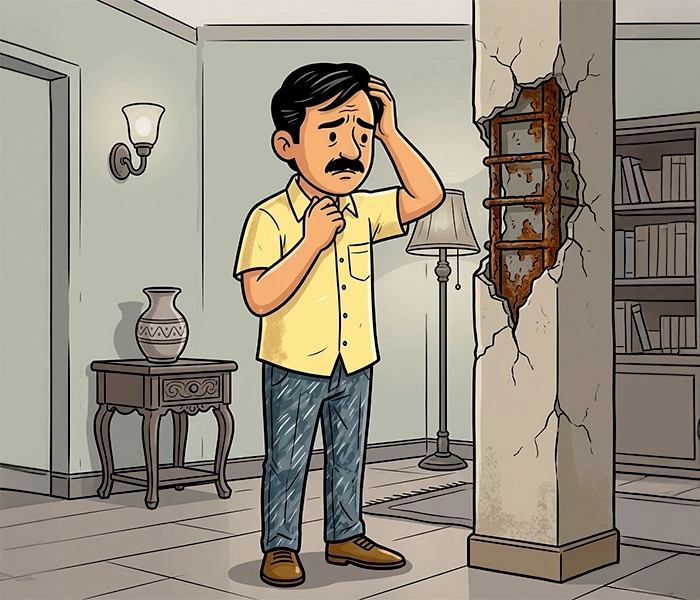
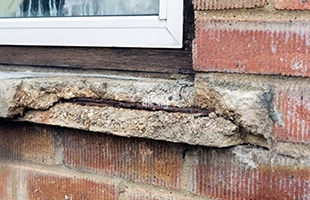
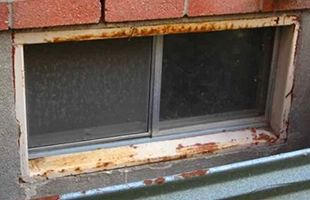
There is perhaps no visual more terrifying for a property owner or a housing society manager than looking up and seeing the internal skeleton of their building exposed and decaying.
It usually begins as a faint, rust-colored stain seeping through the paint on a ceiling or the underside of a balcony. Then, long, straight cracks start to form along the concrete. Finally, without warning, a heavy chunk of concrete simply breaks off and crashes to the floor, revealing flaky, reddish-brown TMT steel bars beneath.
When this happens, the feeling of safety in your own home vanishes. Every time you park your car in the basement, you look at the crumbling pillars and wonder if today is the day they give way. If you are a builder who recently handed over a project, discovering early signs of corrosion is a nightmare that threatens your reputation and invites massive legal liabilities.
WhyThis Happens: The "Cancer" of Concrete.
To stop the deterioration, you must understand the science of why buildings decay.
Steel is incredibly strong, but it has one fatal weakness: when exposed to oxygen and moisture, it rusts. In engineering terms, the phenomenon of concrete breaking off is called spalling. When a TMT steel bar rusts, it undergoes a chemical reaction that causes it to expand up to six times its original volume.
Here are the common mistakes that trigger this deadly cycle:
- Missing Cover Blocks
- High Chloride Content in Sand and Water
- Using Unverified, Low-Grade TMT Bars
- Poor Roof Waterproofing

This is the number one contractor mistake in India. When casting a roof or pillar, steel must be buried deep inside the concrete (usually 20mm to 40mm deep) to protect it from the air. Contractors often fail to use "cover blocks" (small cement spacers), leaving the steel resting right against the wooden shuttering. As a result, the steel sits dangerously close to the surface, easily exposed to moisture.
Using unwashed river sand, sea sand, or groundwater with high salt (chloride) content is a recipe for disaster. Chlorides act as a catalyst, aggressively eating through the alkaline protection of the cement and attacking the steel almost immediately after construction.
The market is flooded with cheap steel that lacks proper anti-corrosive properties. In humid regions like Eastern India, using standard steel instead of CRS (Corrosion Resistant Steel) in exposed areas drastically accelerates deterioration.
Persistent capillary action and roof seepage act as a constant supply of water to the internal steel framework, feeding the rusting process year after year.
HowINFRAHUB SolvesThe Engineered Pathway
You cannot cure concrete cancer with a coat of fresh paint. Backed by BPCOne’s 23 years of heavy infrastructure legacy-where we engineer railway bridges to withstand decades of harsh weather without rusting-INFRAHUB provides a definitive, scientific remediation strategy to save your decaying structure.
- 1
On-Site Structural Assessment
We begin with a Site Inspection. Our structural engineers use Non-Destructive Testing (NDT) to determine how far the "cancer" has spread. We map out the areas of active corrosion, even those hidden behind seemingly healthy plaster.
- 2
Chemical Diagnosis at INFRA.CLINIC
Before we repair, we must know why the steel rusted. We extract core samples of your concrete and send them to INFRA.CLINIC — our NABL-accredited laboratory. We test the concrete for chloride and sulphate attacks, and test the remaining exposed steel for its residual tensile strength to see if it can still safely hold the building up.
- 3
Engineered Remediation Strategy
Based on the certified lab data, our engineers design a targeted retrofitting plan. The process is meticulous: all spalled concrete is chipped away behind the rusted bar. The steel is mechanically cleaned to bare metal. We then specify the application of zinc-rich epoxy anti-corrosive primers to physically halt the rust, followed by bonding agents.
- 4
Factory-Direct Supply of Structural Repair Materials
Standard cement will not bond to old concrete. INFRAHUB supplies industrial-grade, non-shrink micro-concrete and polymer-modified mortars directly to your site, ensuring the repaired section is actually stronger than the original pillar or ceiling.
Releated Services
Site Inspection & Structural Assessment
Have our engineers map out the exact extent of the corrosion in your building.
Engineering Consultation
Get a step-by-step, scientifically calculated repair methodology.
Project Management Support
Certify the chloride levels in your concrete and the remaining strength of your TMT bars.
Releated Products
PROCEMHUB
Procure industrial rust-removers, zinc-rich epoxy primers, bonding agents, and high-strength micro-concrete.
See DetailsBUILDRHUB
Access authentic, lab-verified CRS (Corrosion Resistant Steel) TMT bars for severe replacements.
See DetailsFAQs
Common Questions. Answered Clearly.
Absolutely not. If you do not chemically treat and neutralize the rust first, the oxidation process will continue underneath the new cement. The steel will expand again, and the new cement patch will break off within a few months.
Cover blocks are small spacers made of concrete or PVC. They are placed between the steel reinforcement and the wooden formwork before pouring concrete. They ensure the steel is buried deep inside the concrete (providing 'cover'), which protects it from the moisture and oxygen that cause rust.
Prevention is better than cure. Before you build, INFRA.CLINIC — our NABL-accredited laboratory tests your construction water and sand for dangerous chlorides and sulphates. If we detect high salt levels, our engineers will advise you to change your water source or specify specialized corrosion-resistant cement, preventing the rust from ever starting.
One rusted bar does not mean immediate collapse, but it is a critical warning sign that the protective alkaline environment of your concrete has failed in that area. It requires immediate engineering assessment to ensure the structural load path is still safe and to prevent the corrosion from spreading to the main load-bearing columns.