




Englishবাংলাहिन्दी

Store Locator

INFRA.CLINIC - NABL- Accredited Laboratory
Testing & Diagnostics

Construction material testing lab in Eastern India.

Consult with Engineer →

NABL-accredited laboratory — provides certified material testing, structural diagnostics, and field testing for premium construction across Eastern India.

INFRA.CLINIC

For decades, scientific material testing was a luxury reserved exclusively for massive government infrastructure projects, national highways, and complex railway bridges.

The average premium home builder or commercial developer in Tier 2 and Tier 3 cities across Eastern India simply did not have access to this level of technical validation. INFRAHUB has changed this permanently.

We proudly introduce INFRA.CLINIC.
NABL - Accredited Laboratory

What does NABL accreditation mean for you? NABL stands for the National Accreditation Board for Testing and Calibration Laboratories. In plain language, it means that our testing procedures, our equipment, and our scientists meet the highest, strictest government-recognized standards in India.

A report from a NABL-accredited laboratory is not just a piece of paper; it is a legally valid, scientifically undeniable certification of quality.

This initiative is backed by the profound institutional knowledge of BPCOne.

1000+

Railway Projects premium home budget lost to poor decisions

20+

Earthen Dam Investigations Vendors visited before finding right materials

07+

Long Bridges Time wasted on contractor and material hunting

With 25 Years of experience engineering and constructing some of the most sophisticated and challenging railway bridges, tunnels, and highways in the country, BPCOne understands that world-class structures begin with world-class materials.

Lab Testing Process

What INFRA.CLINIC Tests can help with.

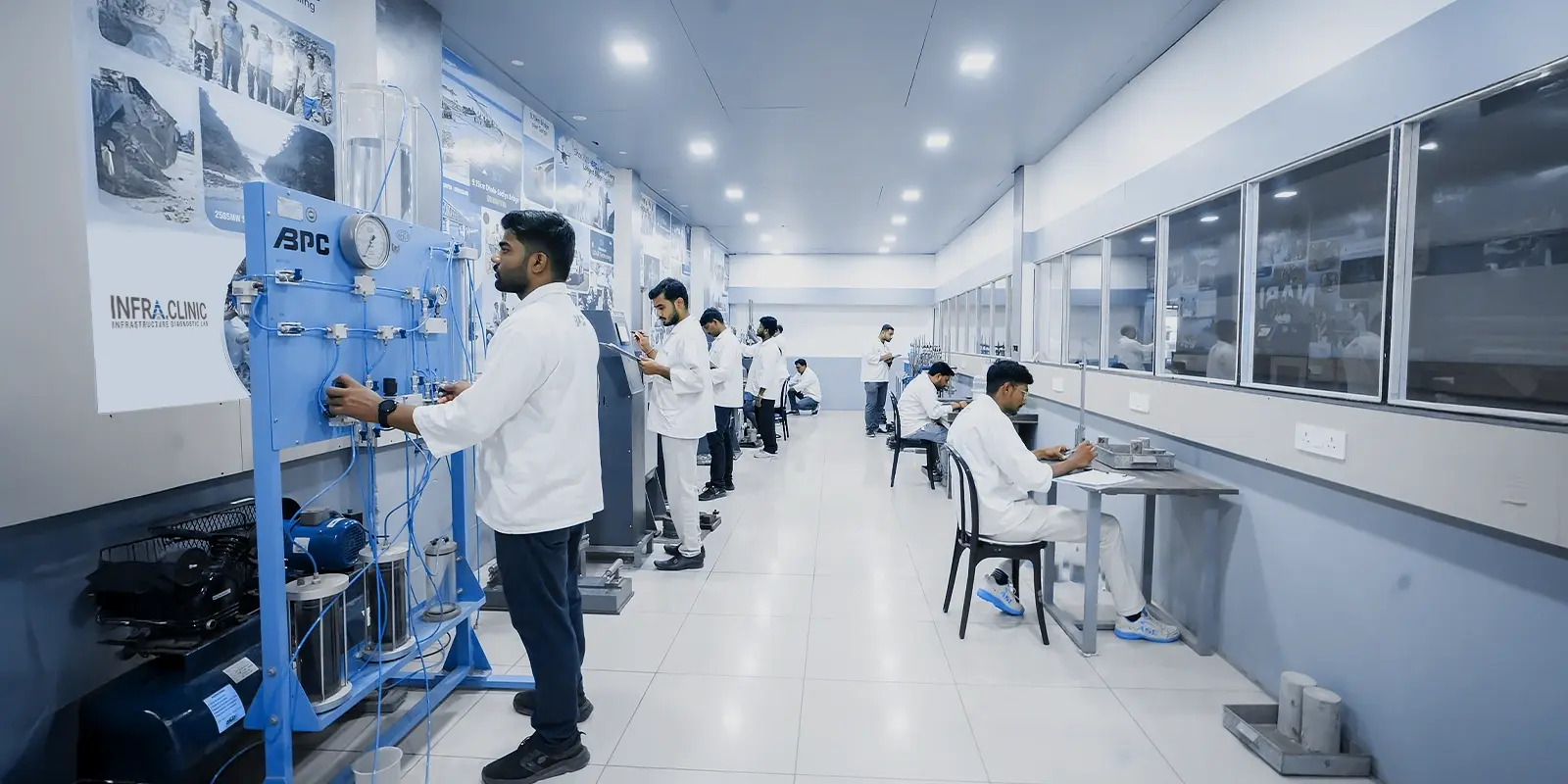
Construction is chemistry and physics. At INFRA.CLINIC — our NABL-accredited laboratory, we break down your building materials to their core molecular and mechanical properties.
  • TMT Steel Bars

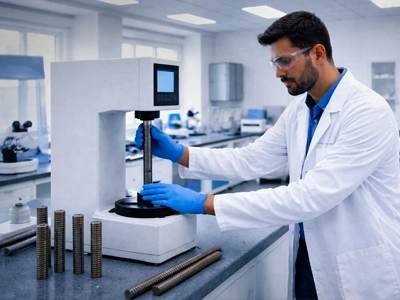
    We do not just look at the ribs on the steel. We use a Universal Testing Machine (UTM) to pull the steel until it snaps. We measure its exact mechanical limits under controlled laboratory conditions.

    1. Tensile Strength How much it can stretch before breaking
    2. Yield Stress The point at which it permanently deforms
    3. Chemical analysis Carbon and sulphur levels balanced for earthquake resistance
  • Cement Quality and Grade

    We verify if the cement you bought actually matches the grade printed on the bag — ensuring it will bind your structure securely without cracking over time.

    1. Compressive Strength Grade verification against bag specifications
    2. Initial and Final Setting Time Workability and cure confirmation
    3. Fineness Particle size and binding quality assessment
  • Concrete Cube Strength

    Before you cast your roof slab, you need to know the concrete mix is right. We test casted concrete cubes at 7-day and 28-day intervals under immense hydraulic pressure to certify their exact load-bearing capacity.

    1. 7-day interval testing Early-stage strength confirmation
    2. 28-day interval testing Full cure strength certification
    3. Hydraulic pressure certification Exact load-bearing capacity per cube
  • Waterproofing Membranes and Chemicals

    We test anti-damp compounds, epoxy grouts, and elastomeric coatings for Impermeability and Adhesion Strength, proving they will actually stop capillary action and seepage before you apply them to your walls and floors.

    1. Impermeability Capillary action and seepage resistance under pressure
    2. Adhesion Strength Bond performance under load and temperature change
    3. Anti-damp, epoxy grout, and elastomeric coating certification
  • Soil Bearing Capacity

    A building is only as strong as the earth beneath it. We test soil samples for,

    1. Moisture Content, Density, and Bearing capacity to tell your engineer exactly how deep and wide your foundation needs to be.
  • Water for Construction Use

    Mixing premium cement with bad water destroys the concrete's strength. We test your site water for,

    1. pH levels, chlorides and sulphates to ensure it is chemically safe for construction.
  • Bricks and Blocks

    We test red bricks and AAC blocks for,

    1. Compressive Strength
    2. Water Absorption to prevent dampness
    3. Efflorescence the white salty patches that ruin plaster
  • Aggregates (Sand and Stone)

    We conduct Sieve Analysis and test for,

    1. Silt Content Too much silt in your sand will dramatically weaken your concrete and cause your plaster to peel.

Field and In-Situ Testing

We conduct rigorous field tests to ensure the quality and performance of our materials in real-world conditions.

INFRAHUB's dedicated field engineering team is equipped to conduct rigorous "in-situ" (on-site) diagnostics. This is where field expertise and laboratory precision work hand-in-hand.

  • NDT Test

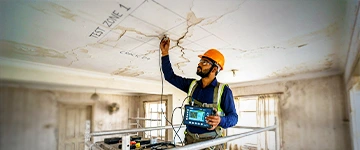
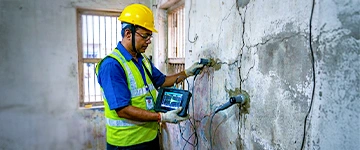
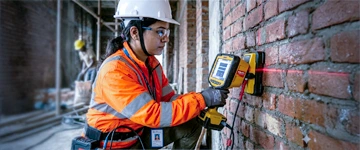
    If you are renovating an older home or purchasing an existing commercial building, our engineers use Non-Destructive Testing (NDT) methods to "X-ray" your existing concrete pillars and beams — determining their internal strength and detecting hidden cavities without breaking a single brick.

    1. Rebound Hammers
    2. Ultrasonic Pulse Velocity meters
    3. Internal cavity detection
    4. Concrete strength mapping
  • Concrete Inspection

    We verify if the cement you bought actually matches the grade printed on the bag — ensuring it will bind your structure securely without cracking over time.

    1. Core sampling and testing
    2. Surface hardness testing
    3. Carbonation depth measurement
    4. Structural integrity assessment
  • Damp/Leakage Testing

    We verify if the cement you bought actually matches the grade printed on the bag — ensuring it will bind your structure securely without cracking over time.

    1. Moisture content measurement
    2. Water permeability tests
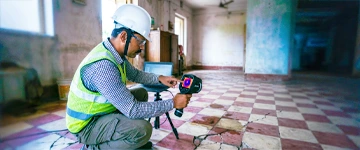
    3. Infrared thermography
    4. Capillary rise tests
  • Structural Inspection

    We verify if the cement you bought actually matches the grade printed on the bag — ensuring it will bind your structure securely without cracking over time.

    1. Visual inspection for cracks and defects
    2. Measurement of cover depth
    3. Rebound hammer tests
    4. Ultrasonic pulse velocity tests

Our Transparent Testing Process

We have designed our diagnostic process to be smooth, transparent, and completely integrated into your construction timeline.

  • 1

    Enquiry & Sampling

    ou contact INFRAHUB. Based on your project stage, we advise you on what needs testing. Our trained personnel will either collect the samples directly from your site using standardized protocols, or guide you on how to submit them.

  • 2

    Scientific Testing

    he samples arrive at INFRA.CLINIC — our NABL-accredited laboratory. They are logged, barcoded to remove any bias, and subjected to rigorous testing by our material scientists using calibrated machinery.

  • 3

    Data Analysis

    The raw data is reviewed by our senior structural engineers, who cross-reference the results against strict Indian Standard (IS) codes.

  • 4

    Certified Report Delivery

    You receive a detailed, easy-to-understand, certified test report.

Who Uses INFRA.CLINIC?

Because facts matter more than opinions, a wide variety of stakeholders rely on our testing.

Premium Home Builders

Individuals who refuse to compromise on the safety and longevity of their family's primary residence.

Commercial Developers

Owners building resorts, hospitals, or retail showrooms where structural integrity is tied directly to business continuity and public safety.

Contractors and Builders

High-quality contractors use our reports to prove the excellence of their workmanship and the authenticity of their materials to their clients.

Architects and Structural Engineers

Professionals who need independent, certified data to validate their design assumptions.

Government Projects

Requiring mandatory NABL-accredited compliance for public infrastructure.

Legal and Insurance Entities

Needing undeniable scientific evidence to resolve structural disputes, building failures, or insurance claims.

The Anatomy of a Sample Test Report

We do not just hand you a piece of paper with a number on it. When you receive a certified report from INFRA.CLINIC - our NABL-accredited laboratory, you receive a document of absolute authority.

A standard INFRA.CLINIC report features a secure QR code for digital verification, preventing any tampering or forgery. It proudly displays the NABL accreditation seal. The document clearly lists the material tested, the specific Indian Standard (IS) code applied, the exact parameters tested, the observed values from our machinery, and the acceptable limit range.

Most importantly, it concludes with a definitive, unambiguous "Pass/Fail" or "Verified" stamp, signed by our chief laboratory scientist. It is a document designed to give you, your engineer, and your contractor absolute clarity.


FAQs

Common Questions. Answered Clearly.

Turnaround times depend entirely on the nature of the test. Physical tests like TMT steel tensile strength or brick compression can be completed and reported within 3 to 5 working days. However, chemical tests or time-dependent tests like the 28-day concrete cube compressive strength require their natural duration to provide accurate scientific data. We always provide a clear timeline upon sample collection.

We test the entire spectrum of primary construction materials. This includes TMT steel bars, all grades of cement, casted concrete cubes, fine and coarse aggregates (sand and stone chips), red bricks, AAC blocks, soil samples, construction water, and modern waterproofing chemicals and epoxy grouts.

Yes. INFRA.CLINIC — our NABL-accredited laboratory meets all the stringent requirements set by the National Accreditation Board for Testing and Calibration Laboratories. This means our testing protocols, equipment calibration, and data accuracy are officially recognized by the Government of India, making our reports legally valid and scientifically undeniable.

Submitting a sample is simple. You can call our hotline or fill out the online form to request a sample pickup. Our field team will visit your site, ensure the sample is collected using proper scientific methods (to avoid contamination), and transport it securely to the lab. Alternatively, you can drop off approved samples directly at our physical Hub.

A certified report contains the sample details, the date of testing, the specific IS codes used as benchmarks, the exact parameters tested (like yield stress or compressive strength), the actual observed results, the acceptable standard limits, and a final, clear verification of whether the material passed or failed. It includes the NABL seal and the signature of our authorized technical manager.